
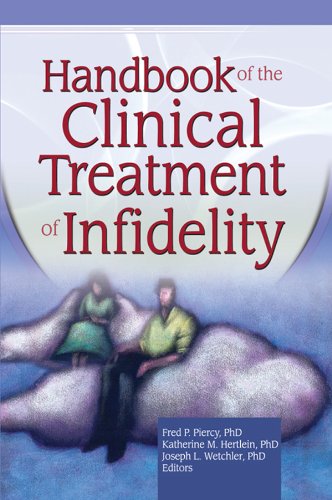
Handbook of the Clinical Treatment of Infidelity 1st Edition, Kindle Edition
Product details
| Management number | 222072503 | Release Date | 2026/05/04 | List Price | US$20.97 | Model Number | 222072503 | ||
|---|---|---|---|---|---|---|---|---|---|
| Category | |||||||||
Help your clients’ relationships survive infidelity!In the Handbook of the Clinical Treatment of Infidelity, a panel of seasoned experts reflects on issues central to affairs, and on how to help couples heal and learn from them. First, editors Fred P. Piercy, Katherine M. Hertlein, and Joseph L. Wetchler provide an essential overview of infidelity theory, research, and treatment. They discuss the effect of infidelity on couples and delineate three types of infidelityemotional, physical, and infidelity including aspects of both. They review the relatively new role of the Internet in infidelity and explore infidelity within the context of comarital relationships. Finally, they discuss the overarching theories and common models used in infidelity treatment.Also in the Handbook of the Clinical Treatment of Infidelity: Susan M. Johnson, the co-developer of Emotionally Focused Therapy (EFT), discusses affairs through the lens of attachment theory, and shows how EFT provides a way to acknowledge and express pain, remorse, and regret, and to repair this attachment bond. David Moultrup takes a Bowenian approach to infidelity, focusing attention on the underlying dynamics of the emotional system Frank Pittman and Tina Pittman Wagers outline cultural myths about affairs and do their share of debunking Adrian Blow discusses how to help couples directly address their painand the challenges of the healing process Brian Case highlights the role of apology and forgiveness in the healing process Frank Stalfa and Catherine Hastings focus on the treatment of accusatory sufferinga spouse’s obsessive holding onto and retaliating for an affair long after it has ended, and despite the offending partner’s repeated apologies and attempts at restitution Don-David Lusterman discusses individuals who have suppressed or denied traumatic stress reactions to their partner’s affair, and how to help them Scott Johnson discusses myths about affairs, from who is cheating on whom, to whether men really have more affairs than women, to the blame-filled language of affairs, betrayal, and infidelity, asking us to think more systematically about affairs and to see the dynamics of extra dyadic relationships as more complex and nuanced than they are typically portrayed in the literature Joan Atwood provides an overview of Internet infidelitythe factors influencing one’s involvement in this type of infidelity, and some considerations for therapists Tim Nelson, Fred Piercy, and Doug Sprenkle report on the results of a multi-phase Delphi study that explored what infidelity experts say are the critical issues, interventions, and gender differences in the treatment of Internet infidelity Monica Whitty and Adrian Carr draw upon Klein’s object relations theory and discuss how this might influence the way people rationalize their Internet infidelity Emily Brown outlines the concept of the Split Self Affairdiscussing its origins, characteristics, and implications for individuals and couples, and providing detailed information on how to work with these couples in therapy Michael Bettinger presents extra dyadic relationship as a fact, rather than a problem, within many gay male relationshipsa discussion that shows how gay male polyamory can work as an alternative to the heterosexual model of emotional and sexual exclusivity in romantic dyadic relationships Katherine Hertlein and Gary Skaggs report on the results of a study that assessed the level of differentiation and one’s engagement in extra dyadic relationshipsThe Handbook of the Clinical Treatment of Infidelity is essential reading for today’s (and tomorrow’s) clinicians who work with couples. Make it a p Read more
Bestseller ranking
Bluetooth Car Amplifiers
Customers who viewed this product also viewed
Hardware Tools


Correction of product information
If you notice any omissions or errors in the product information on this page, please use the correction request form below.
Correction Request Form